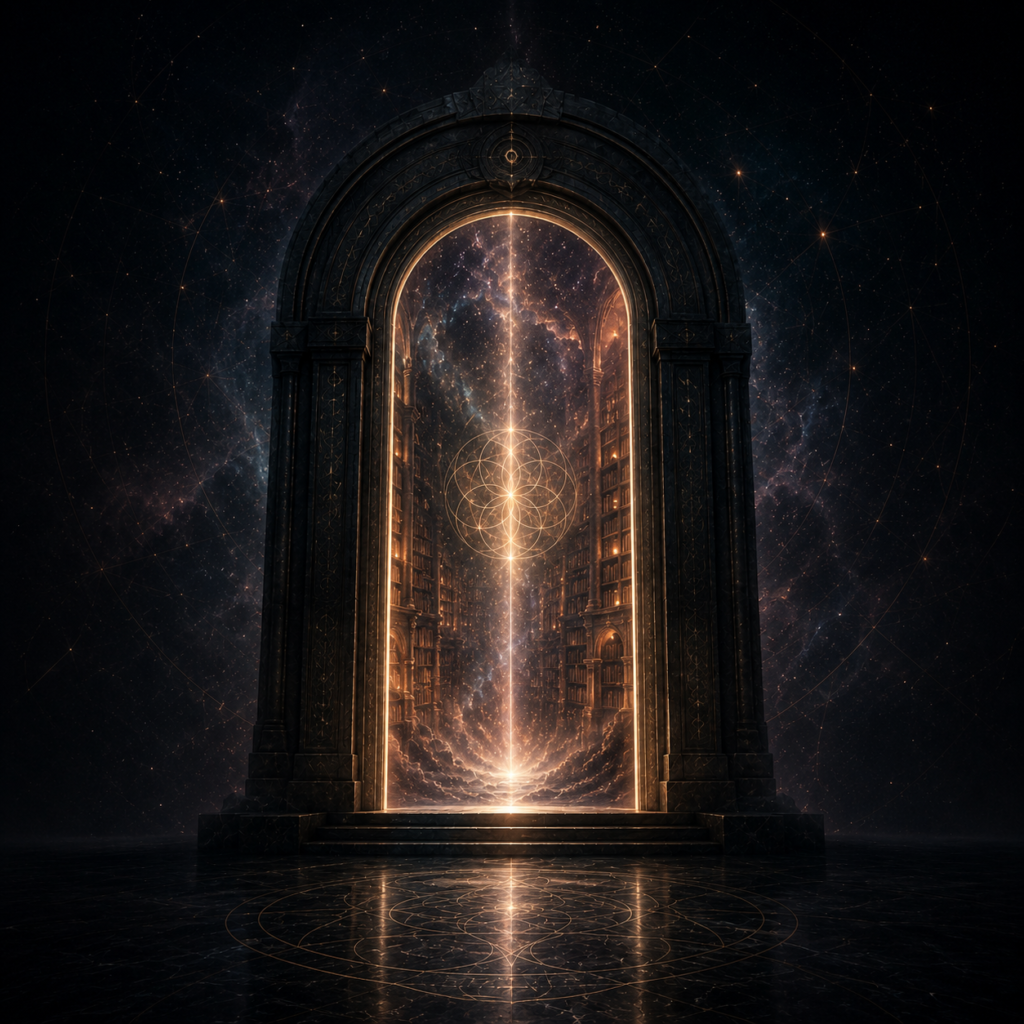
My theological position is grounded in a non-dual, monistic understanding of reality: that all existence is fundamentally one, and that all distinctions—between self and other, matter and spirit, or human and divine—are relative expressions of a single underlying reality.
At the most basic level, nothing can be created or destroyed; everything that exists is an ongoing transformation of the same foundational energy. This implies that all beings, forms, and phenomena are not separate in essence, but are differentiated manifestations of one continuous field of being. What we perceive as division is a function of form, perspective, and spacetime—not an ultimate separation.
From this perspective, “God” is not a separate, external authority, but the totality of existence itself—the unified source and substance of all that is. God is not a being among beings, but Being itself: the infinite, ever-present reality expressing itself through all forms.
Because of this, no individual, group, or tradition holds exclusive access to truth or divine authority. Any claim that a particular people, text, or system uniquely represents God—especially when it excludes others—is a distortion of the underlying unity of reality. Such claims often reflect historical, cultural, or political forces rather than genuine insight into the nature of existence.
This does not mean that all ideas are equally true. While all beings share the same essential nature, interpretations of reality can be more or less aligned with that truth. A valid spiritual or philosophical framework must be coherent with the fundamental nature of reality—namely, unity, continuity, and the non-absolute nature of distinction. When systems promote division as ultimate, or rely on fear, exclusion, or unquestioned authority, they depart from that alignment.
I do not reject the possibility of revelation or spiritual insight. On the contrary, I affirm that human beings can and do experience profound forms of awareness that connect them to a deeper, unified consciousness. However, all such experiences are subject to interpretation, and interpretation can be flawed. What is often presented as divine revelation may instead be a mistranslation of genuine insight through the lens of fear, culture, ego, or the desire for control.
For this reason, no claim to authority—spiritual or otherwise—should be accepted without examination. True guidance must be grounded in a clear and rational understanding of the nature of reality, not merely asserted. Authority that demands belief without demonstrating coherence with the structure of existence is indistinguishable from false authority.
Ethically, a non-dual understanding leads to a principle of universal justice: because all beings are expressions of the same underlying reality, they should be treated with equal moral consideration. Harm to others is, in a real sense, harm within the same unified system of being. Justice, therefore, is not about obedience to imposed rules, but about alignment with the deeper truth of interconnection.
In this view, spirituality is not adherence to doctrine, but the ongoing recognition and embodiment of unity. It is the process of seeing through the illusions of separation and acting in accordance with the reality that all is one.
I’m Spiritual, But Not Religious
I do not reject spirituality. Quite the contrary: ALL THINGS ARE SPIRIT. What I reject is the distortion of spirituality, and its narrowing corruption as “religion.”
Throughout history, what we call “religion” has been a mixture of two things:
- genuine insight into the nature of existence
- and the corruption of that insight through human fear, power, and control
At their root, many religious traditions begin with a real encounter—an awakening, a revelation, a deep intuitive recognition of unity, interconnection, or divine presence. These insights are not the problem.
The problem is what happens next.
The Corruption of Insight
When insight becomes institution, it becomes vulnerable to distortion.
What begins as:
“All is connected”
becomes:
“We are chosen.”
What begins as:
“Truth is universal”
becomes:
“Truth belongs to us.”
What begins as:
“Awaken to what is”
becomes:
“Believe this or be condemned.”
This is not spiritual evolution.
It is the narrowing of truth into a tool of identity and control.
False Authority
Traditional theology often rests on a single claim:
“This is the word of God.”
But a claim is not proof.
Authority—especially spiritual authority—cannot be established by declaration alone. It must be grounded in a coherent understanding of the nature of reality itself.
Any system that:
- demands belief without demonstrating truth
- asserts authority without understanding
- or threatens punishment for questioning
is not expressing divine wisdom.
It is asserting control.
A tyrant can claim revelation.
A frightened mind can misinterpret insight.
A culture can elevate its own story into absolute truth.
Without grounding in reality, these claims are indistinguishable.
The Problem of Exclusivity
Perhaps the clearest sign of distortion is exclusivity.
Any theology that claims:
- one true path
- one chosen people
- one final authority
is in direct contradiction with the nature of reality as I understand it.
If existence is fundamentally unified—if all beings arise from the same underlying source—then no single tradition can claim ownership over truth.
Truth cannot belong to one group.
God cannot belong to one narrative.
Reality cannot be divided in essence.
Exclusivity is not revelation.
It is identity formation.
Fear as a Tool
Many traditional systems rely on fear to sustain belief:
- fear of punishment
- fear of exclusion
- fear of eternal consequence
But fear does not reveal truth—it enforces compliance.
A spirituality rooted in fear is not aligned with reality.
It is aligned with control.
Revelation and Mistranslation
I do not reject the possibility of revelation.
Human beings are capable of profound insight—of encountering something beyond the ordinary limits of thought and perception. I believe this happens.
But insight is not the same as interpretation.
What is experienced as unity can be interpreted as authority.
What is felt as connection can be translated into command.
What is beyond language can be reduced into doctrine.
Revelation may be real.
But what we call religion is often its mistranslation.
A Different Foundation
My rejection of traditional theology is not rooted in rebellion, but in coherence.
I hold that:
- reality is fundamentally unified
- all distinctions are relative, not absolute
- no system has exclusive access to truth
- and any valid framework must align with these principles
From this standpoint, much of traditional theology does not hold.
Not because it contains no truth—
but because truth is mixed with distortion.
Conclusion
I do not reject religion because I reject God.
I reject religion because I reject the claim that God can be confined:
- to a text
- to a doctrine
- to a people
- or to a system of belief enforced by fear and authority
Spirituality, to me, is not about submission to a structure.
It is about the recognition of what is already true:
That all is one.
That truth is universal.
And that no voice that divides us from that unity speaks with ultimate authority.
PORTAL TO MY PROJECTS