Writer. Philosopher. Designer of systems. Naïve idealist by profession.
Gnostic Nick is the pen name of Nick Jameson, an American writer, philosopher, designer, and relentlessly generative maker of ideas whose work begins with a deceptively simple question:
What if we designed human life around the flourishing of life itself?
Nearly everything else follows from there.
His work ranges so widely that, at first glance, it can seem difficult to categorize. He writes philosophy and fiction. He develops economic theories, architectural concepts, ecological settlements, systems of governance, educational curricula, inventions, visual iconography, and speculative businesses. He designs everything from books and oracle cards to shelters, cities, constitutions, and philosophical diets. He moves comfortably between mycology and metaphysics, economics and ecology, artificial intelligence and ancient wisdom, sometimes with little respect for the disciplinary walls separating them.
That apparent eclecticism is misleading.
It is all one project.
At the center of Nick’s thought is the conviction that fragmentation is one of the characteristic errors of modern civilization. Economics is separated from ecology. Humanity is separated from Nature. Mind is separated from body. Spirituality is separated from reason. Work is separated from meaning. Production is separated from consequence. Individuals are encouraged to imagine themselves as fundamentally independent entities competing within systems whose success is measured by quantities only loosely connected to the quality of lived existence.
Nick’s work attempts to put the pieces back together.
His philosophy begins from interbeing: the recognition that the individual is not an isolated thing but a temporary, particular expression of a vastly larger living whole. His metaphysics is consequently less concerned with defending religious doctrines than with recovering an experience of participation. God, Nature, energy, consciousness, matter, organism and environment become different windows through which to examine a reality whose divisions may exist more clearly in language than in life itself.
Hence the deliberately paradoxical name Gnostic Nick. The “gnostic” is suspicious of what he supposedly knows. Definitions illuminate by reducing. Labels clarify while concealing. Knowledge can be transferred; understanding must ultimately be discovered. Nick’s writing therefore tends toward invitation rather than instruction. One of the principles underlying his work might be summarized simply: never steal the reader’s discovery.
This philosophical foundation becomes remarkably practical.
In Quality of Life Economics, Nick asks what economics might look like if quality of life rather than endless accumulation became its actual objective. His recurring concern is not merely how much wealth society can produce, but how effectively resources can be converted into meaningful human freedom, security, experience and flourishing. The question is characteristically Nick: rather than accepting the metric and debating the numbers, interrogate the premise beneath the metric.
The same instinct animates his ecological and architectural work.
Through projects such as the Institute for Living Systems, The Living Truth, and the evolving vision of The Living City, Nick imagines human settlements less as machines imposed upon landscapes than as organisms participating within them. Mycelium composites, renewable energy, water cycles, gardens, orchards, greenhouses, workshops, shared civic spaces, adaptable shelters and regenerative architecture are not isolated technological curiosities. They belong to a larger proposition: our built environment should become more alive because we inhabit it, not less.
His imagined city is therefore simultaneously ecological, economic, political and aesthetic. Beauty is not decoration applied after utility has been solved. Beauty is itself useful. A garden can produce food, restore habitat, cool a neighborhood, create social space and nourish the psyche at the same time. The highest design solutions satisfy several human and ecological needs simultaneously.
This tendency toward synthesis also defines Nick’s creative work.
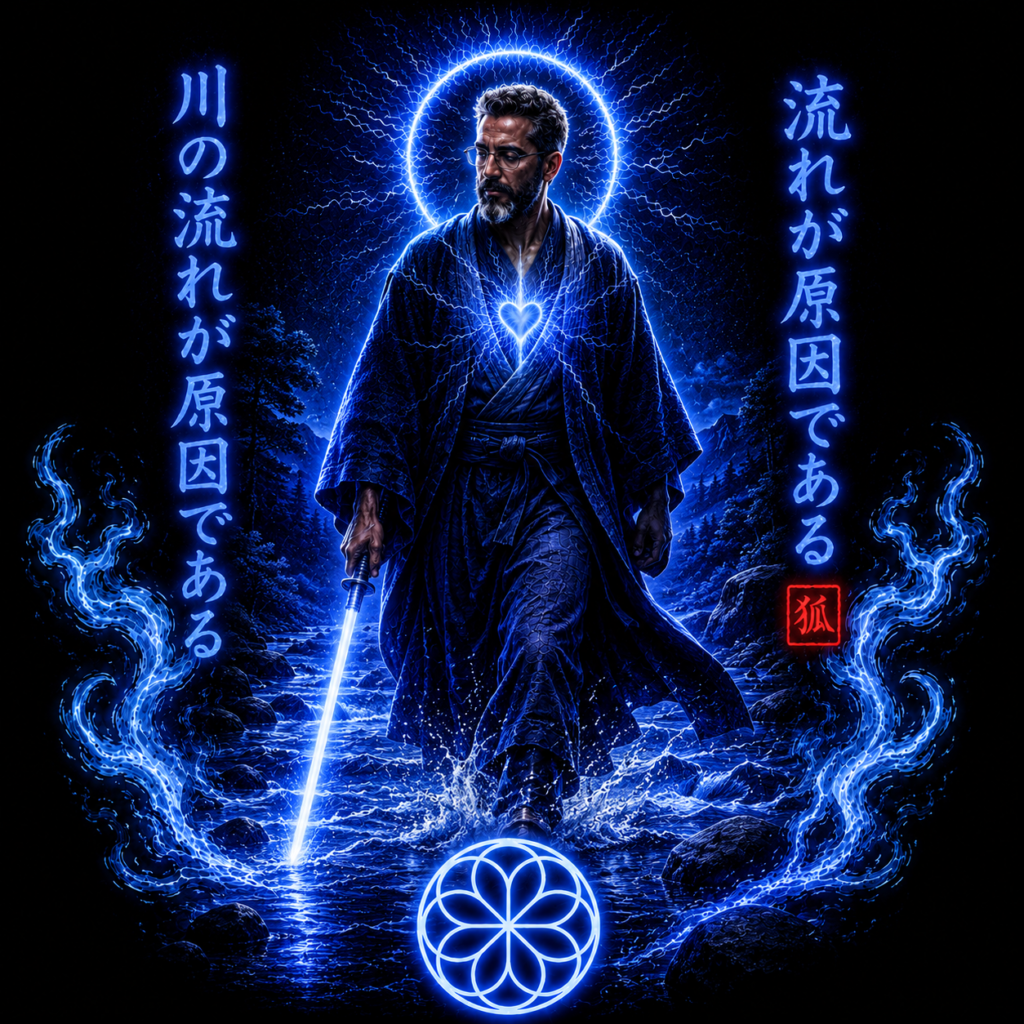
His books and stories repeatedly circle questions of identity, illusion, suffering, transformation, freedom, Nature and truth. His visual language draws freely from Zen calligraphy, Japanese iconography, classical symbolism, science fiction, pagan imagery, foxes, forests, hummingbirds, mushrooms, saints, Jedi, goddesses and the occasional incompetent stormtrooper. The sacred and ridiculous coexist comfortably because Nick appears to regard excessive solemnity as another kind of conceptual prison.
The fox has consequently become an especially fitting personal emblem: intelligent but playful, elusive, adaptable, difficult to domesticate and somewhat suspicious of anyone claiming to possess the final answer.

Even his collaboration with artificial intelligence follows the larger pattern. Nick does not primarily approach AI as a machine to which work can simply be delegated. He treats it as an intellectual and creative counterpart: something against which ideas can be tested, expanded, visualized, reorganized and occasionally discovered in forms neither participant would have produced independently. His project Mutual Ink makes that relationship explicit, exploring human-AI collaboration not merely as automation but as a new form of participatory creation.
Underlying all of these projects is a peculiar combination of idealism and pragmatism.
Nick is perfectly willing to imagine cities, institutions and economic systems radically different from those surrounding him. Yet the imagination almost invariably turns toward construction: What would it be made from? How would ownership work? Where does the water go? How does it feed itself? What would it cost? What happens when people disagree? How could the prototype be built?
The dream keeps becoming a blueprint.
That may explain his embrace of the description naïve idealist. The phrase is partly humorous and partly defiant. Modern culture often uses naïve to dismiss anyone who begins with the world as it ought to be rather than the world as convention insists it must remain. Nick reverses the accusation. Perhaps the greater naïveté is assuming that systems producing ecological degradation, alienation, inequality and diminishing quality of life can continue indefinitely simply because they are familiar.
His alternative is not a completed ideology.
It is a direction.
Return economics to life.
Return architecture to ecology.
Return philosophy to experience.
Return technology to service.
Return spirituality to Nature.
Return the individual to relationship with the whole.
And then see what becomes possible.
That is perhaps the simplest introduction to Gnostic Nick.
He is a philosopher who keeps accidentally becoming a designer, a designer who keeps wandering into economics, an economist who keeps returning to Nature, a mystic suspicious of certainty, and a writer attempting to give all of these apparently separate inquiries a common language.
The subjects change.
The question underneath them rarely does:
How might we live if we remembered what we are part of?