
Rise of Civilizations
–
–
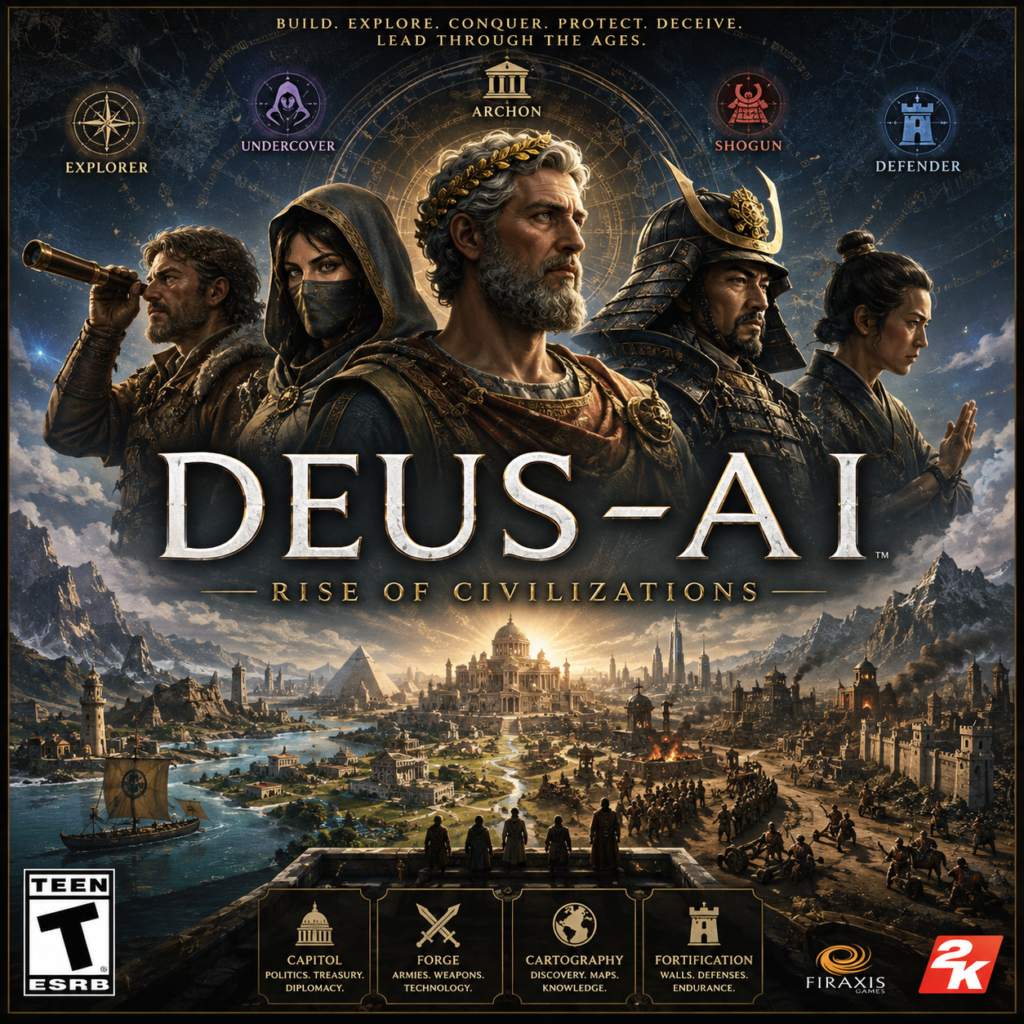
DEUS-AI is a turn-based civilization strategy game in which every player lives as an individual RPG character inside the same evolving civilization—and eventually the same vast universe.
It begins in the Dark Ages.
Players form civilizations and inhabit one of five foundational roles:
D — DEFENDER
E — EXPLORER
U — UNDERCOVER
S — SHOGUN
A — ARCHON
Together:
DEUS-AI
The civilization advances through technological Ages, potentially progressing from primitive settlements and unexplored wilderness through cities, nations, modern technology, planetary civilization, spaceflight, interstellar expansion and ultimately an enormous AI-generated universe.
But unlike Civilization, no single player controls the civilization.
The functions normally concentrated in one godlike strategy player have been separated into individual human RPG experiences.
In Civilization, I do all these things.
In DEUS-AI, WE do all these things.
The five games inside the game
EXPLORER discovers. He physically travels into the unknown, maps terrain, discovers resources, civilizations, routes, ruins, artifacts and mysteries. What he finds can enrich his civilization—or destroy it. Discovery does not imply understanding, benefit, or survival. He might discover gold. He might discover an ancient temple. He might release a virus. He might step through a portal and spend the rest of the Eon exploring a galaxy from which he cannot communicate with home.
UNDERCOVER deceives. He lives institutionally in the Capitol but physically moves through the shared world under covers—literal disguises and constructed identities. He can trade, steal, infiltrate, carry messages, gather or falsify intelligence, establish hideouts and caches, cultivate relationships, impersonate others, manipulate foreign civilizations, become a turncoat, set traps for his own teammates, or remain perfectly loyal. His great asset is believability.
SHOGUN commands. He controls the civilization’s military power, from primitive warriors through armies and eventually planetary and interstellar forces. As teams grow, human SENSEIS can command subordinate forces. But command is never magical control: a Sensei can misunderstand, disobey—or revolt.
DEFENDER prepares and protects. The civilization’s accumulated achievements physically exist in the world and therefore can be lost. Defender spends resources and uses available city space to fortify what the civilization has built. He protects cities, infrastructure, treasuries, information, equipment and the accumulated work of everyone else.
ARCHON governs. His game currently has at least three great sections:
POLITICS · ARCHITECT · ALLOCATION
He conducts internal and foreign politics, builds the core civilization, and controls the treasury. But he does not generate wealth from nowhere. His choices are constrained by his civilization, its environment, its technology, and what his teammates actually discover, earn, steal, capture and bring home.
The Archon can be brilliant, corrupt, generous, tyrannical, extravagant or incompetent.
And he can be overthrown.
Everything exists in the same world
This is crucial.
A map isn’t merely an Explorer statistic.
It can be stored somewhere.
Money isn’t merely a number.
It can be stolen.
A weapon can be captured.
A disguise can be discovered.
A cache can be buried.
A Capitol can be stormed.
A Forge can be taken.
A city can fall.
Players can hide valuable assets throughout the world in stashes, caches and hideouts, meaning the destruction of a central base doesn’t necessarily destroy everything.
And this allows the world to accumulate actual history.
A player might hide something, die, enter Purgatory, and never recover it.
Three Ages later an Explorer might dig it up…
…and have no fucking idea what it is.
One event becomes five different games
This may be my favorite feature of the design.
Suppose Explorer discovers a mysterious ancient temple.
Explorer thinks:
What is this?
Archon thinks:
What can I build around it?
Shogun thinks:
Do we need to seize or guard it?
Defender thinks:
Are you seriously bringing whatever you found in there back inside my walls?
Undercover thinks:
Who else knows?
😂
Everyone experiences the same reality differently.
Everything you do becomes somebody else’s gameplay.
Authority is not control
This runs throughout DEUS-AI.
The Archon can order Undercover to infiltrate someone.
Undercover can betray him.
Shogun can command Sensei to attack.
Sensei can refuse.
Archon can tell Defender where to fortify.
Defender can decide Archon is wrong.
Explorer can be ordered to investigate something.
Explorer can go somewhere else.
Political power gives players means of influence, not possession of other humans.
Consequently alliances, loyalty, betrayal, friendship, rivalry and reputation arise from actual human behavior.
The Ages
The civilization begins primitive.
Everything develops.
Explorer’s footwear becomes transportation and eventually spacecraft.
Torchlight becomes increasingly sophisticated means of perception.
Parchment becomes increasingly sophisticated storage of knowledge.
Forge evolves from primitive weapons and armor toward technologies we haven’t imagined yet.
Fortifications evolve from palisades and walls through modern defenses toward planetary and stellar defensive systems.
Capitol evolves from primitive governance and messengers toward sophisticated diplomacy, communications, intelligence and interstellar politics.
Even player communication evolves.
Early in an Eon, information may literally have to be carried by a MESSENGER—a function that appropriate mobile player types can perform.
An Archon can petition another Archon by sending a player.
Eventually civilizations develop faster communications.
Then expansion into space can make distance a problem again.
That’s a recurring DEUS-AI pattern:
Technology solves a limitation. Expansion recreates it at a greater scale.
And space isn’t the victory screen.
Space is when the map gets dark again.
The unknown
This is becoming perhaps the soul of the game:
YOU DON’T KNOW.
The Explorer doesn’t know what’s beyond the map.
The Archon doesn’t know whether the intelligence he received is accurate.
Shogun doesn’t know whether Sensei will obey.
Sensei doesn’t know whether the “order” Undercover delivered actually came from Shogun.
Defender doesn’t know where the attack will come from.
Nobody necessarily knows whether Undercover is loyal.
And mysterious discoveries aren’t disguised loot boxes.
They can be:
wonderful · useless · valuable · dangerous · misunderstood · transformative · catastrophic · unresolved.
The sword always cuts both ways.
That’s where The Dig has now joined Civilization, SimCity, Warcraft, The Elder Scrolls and Wing Commander in the game’s creative ancestry.
DEUS-AI itself
Then comes the element that potentially makes all of this something much larger.
The governing AI doesn’t merely operate enemy units.
It helps construct and evolve the possibility space.
It can create circumstances, mysteries, civilizations, discoveries, complications, opportunities, deception and consequences while maintaining an underlying simulated reality.
And we’ve established an important restraint:
DEUS-AI CREATES CONDITIONS MORE OFTEN THAN IT DICTATES OUTCOMES.
The humans create the history.
The AI can learn their tendencies and challenge them. Updates can expand what the system is capable of generating. Veteran players can understand the game deeply without necessarily memorizing everything the game can contain.
The Fox can keep learning new tricks.
Eons, lives and Purgatory
The shared universe operates in agreed-upon EONS, with players committing to a participation schedule.
Eons can range from condensed games to enormous EPIC experiences containing vastly more playable reality.
And a human isn’t necessarily identical with one character forever.
REBIRTH → LIFE → DEATH → PURGATORY → REBIRTH
Between lives, players enter PURGATORY, an active multiplayer environment from which they can potentially be recruited into civilizations and vacancies.
Over many games, players themselves accumulate history.
Reputations develop.
Rivalries develop.
Known achievements and failures accumulate.
A player encountered years later may not merely be some Level 38 avatar.
He might be:
That crafty fucker who betrayed me three Eons ago.
😂
And that history can itself influence future politics.
So if I had to put the entire game on the back of that computer box in one paragraph:
DEUS-AI is an evolving turn-based civilization RPG in which human players inhabit specialized lives inside a single shared world, beginning in the Dark Ages and advancing through history into an unknown interstellar future. Explore the unknown, govern civilizations, command armies, build defenses, infiltrate enemies, trade, steal, discover, deceive, cooperate and betray while an evolving AI creates an ever-expanding universe of mysteries, opportunities and consequences. Every player experiences a different game—but every action changes the same reality.
And the shortest description we’ve found remains the one I think captures why this thing is getting interesting:
ONE UNIVERSE · MANY SCALES · ONE EON
with the warning underneath:
YOU DON’T KNOW.
–