The World’s First Autonomous Personal Shelter (APS)
In a world of ceaseless doubt, uncertainty and insecurity, one thing matters most:
SHELTER.
I know this foundational fact from numerous overlapping perspectives and their respective insights. Having spent most of my life resisting the unnatural stresses and injustices endemic to conventional society, including resisting the conventional career and all the trappings that accompany it, I’ve long been a rover. Not only do I tend to become restless when I stay too long in any one place, but I’m against leases that force us to enrich the rich and flush most of our money down the drain in doing so, building no ownership for ourselves. This is an oppressive exploitation of the financially-disadvantaged; ‘upward mobility’ sold for the right not to be homeless.
Thus do I tend to bounce around. And while, as a progressive thinker, I’m more aware of injustice and, thus, more averse to conventional society than most, my propensity to roam is by no means limited to me, or to any demographic. We’re vagabonds by nature. That is, humanity has moved seasonally for millennia, always following the warmth and the food sources, yes, but, I believe, also because of what we call ‘the human spirit,’ including the adventurousness calling us towards the discovery and exploration of new places and their heaping feasts of specially-served experiences.
Moreover, I worked in mental health for years, and have, with dismay sometimes verging upon anguish, observed the homelessness issue in every area in which I’ve lived. So many sit in warmth and invest most of their ‘disposable income’ in luxuries whilst so many of their brethren suffer. How, I ask myself repeatedly, can any society look into its collective mirror and, with a straight face, claim to be ‘advanced’ when its ‘upper class’ hoards more wealth than it can ever use to increase the quality of its experience of existence while so many desperately need so much. Inhumanity and advancement are, from any morally-aware perspective, inversely proportionate.
Worse, the overlap between ‘the mentally ill’ and ‘the homeless population’ is so near to perfect that it points to the failure of capitalist society to support its most vulnerable populations as a whole. Why pay a tax to support the disadvantaged when you can cut taxes and sell lies like ‘the trickle-down effect’ that tells the tall tale that the wealth of the so-called ‘1%’ trickles down to everyone, even as the truth is much the opposite: not only do the super-rich tend to hoard their wealth, but they also invest it in everything that makes them richer through the exact same financial and commercial mechanisms that make everyone else poorer whilst unsustainably plundering the planet, increasing every disparity and all inseparable suffering in the process. Why clothe, house and feed someone suffering immeasurably on the street when you can buy an even bigger boat? Worse, conservative politics justifies its inhumanity by blaming these populations for their pains. The result: both homelessness and mental illness diagnoses are reaching catastrophic proportions.
I’ll never forget a passage I once read: “The most concentrated population of the mentally ill and the homeless anywhere on Earth is the Los Angeles prison system.” And those in disaster relief situations and fleeing war-torn nations and their regimes face even greater hardships, arguably, sometimes escaping hurricanes or ethnic cleansing just to find themselves in the further trauma of needing to shelter themselves and their family whilst fighting the xenophobic immigrant-scapegoating that only exacerbates the injustice. We’re all immigrants, even the ‘Native Americans’ whom hail from Asia, having crossed the Bering Straight 10,000 years ago.
Then there’s the human being’s innate love for camping, and the blurring of the line between this pastime of grounding, re-naturalizing, healing immersion in the bountiful bosom of our Holy Mother and what it means, exactly, to say: “I have a home.” On the broadest possible, most fully-inclusive and spiritually-aware level, we all have the same home: NATURE. When the conquerors took the land and claimed to own it and forced the people to pay them for the right to inhabit what belongs to all of life, and when humanity as a whole accepted this as ‘the reality,’ that home was stolen from us.And when it comes to the ‘we all belong to Mother Nature, She doesn’t belong to us’ concept of camping (you can’t own what you’re inseparable from and belong to), there’s the fact that I know, from hearing the related experiences of some of the residents of the mental institution in which I worked, that many amongst the homeless and mentally ill prefer to think of their lack of permanent shelter as akin to camping, largely as a way to ease the psychological burden of their circumstances with the self-soothing affirmation that those circumstances are impermanent.
I’m a camper as well, but have the luxury of going to a cabin built by my father in the redwoods just inland of Fort Bragg, in coastal Northern California. It’s my favorite place to go, especially when I need to purge myself of all societal sickness. It’s my ongoing unplug; my purging of all pestilence; my writers’ retreat and spiritual sanctuary. And I’m constantly having visions of uses for that invaluably-isolated location, with the nearest neighbor being nearly half a mile away, the only sounds (other than sporadic logging trucks rumbling down the road at the bottom of the hill) being the same as those heard by the first immigrants millennia ago. In one such vision I see yurts strewn across the hillsides, perched beneath the soaring red-barked behemoths and spotting the surrounding grassy fields. But most yurts are expensive and difficult to erect, and typically require building pads and other infrastructure.
But not The Bubble Yurt.
ChatGPT has become a major ally for me. After an initial reaction of treating artificial intelligence like the enemy of creative types like me, as something that will supplant writers and others operating within the artistic realm, making it even more difficult to succeed in turning our passions and purpose into financial viability and self-sustainment, a conversation with a tech friend who helped develop AI in its infancy led me to drop that self-defending guard a bit. I’ve since come to realize that the opposite is at least as true: when well-harnessed, AI greatly empowers creators.
The Bubble Yurt represents my latest proof of this principle.
I fed ChatGPT Plus the conception, and it helped me organize and develop all related technical aspects. For, you see, I’ve long had the sense that I need ‘hands-on’ partners in order for my ideas to come to life. I’m a conceptual, creative thinker, but lack the technical training to realize much of my conception. I’m less deductive, more inductive; less closed-system, more open-system. That’s where the AI ‘mind’ steps in.
This is how it started, when I engaged Chat with this:
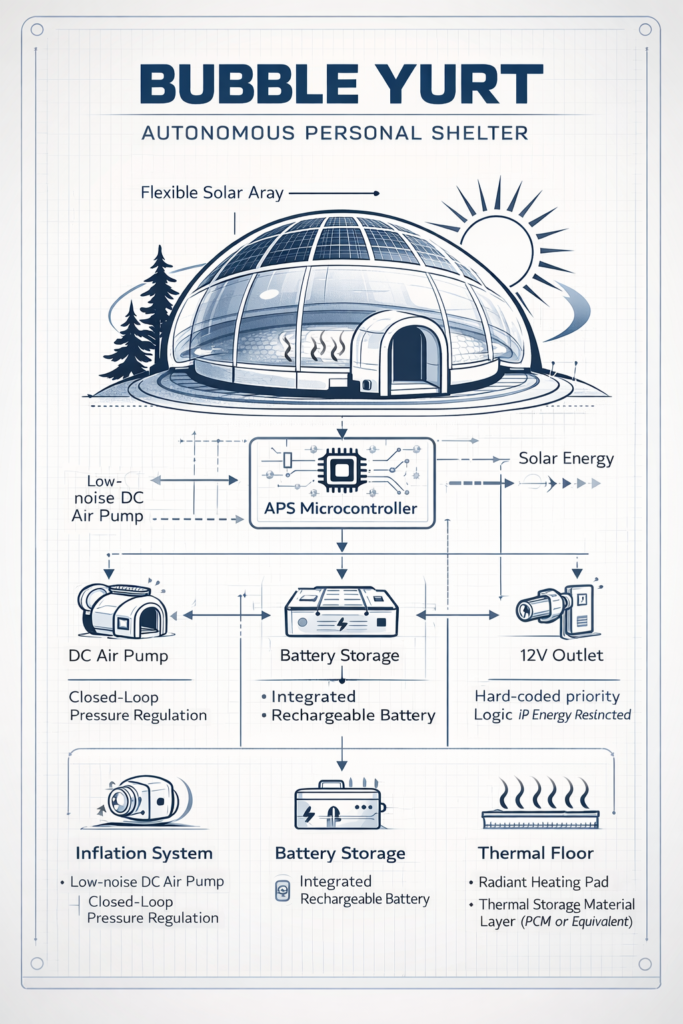
“I have this recurring contemplation of finding, else creating, the perfect impermanent domicile that could serve for everything from setting up a campsite on a property I stay at to welcome guests to being used to address homelessness… Something inexpensive yet as all-inclusive as possible. Recently I envision something plastic that is blown up via a built-in pump, and, ideally, contains a type of solar cell system wherein the cells are integrated, with a built-in battery and plug-in system, such that sun captured during the day by the ‘bubble yurt’ (term I just thought of for it) could be used to power a small heating element also built-into the bubble yurt at night, and/or could allow the resident to charge a cell phone, etc… I think that I’d want the cleanest/most efficient transfer of the solar energy captured during daylight hours into a heating pad built into the floor. The design would be based upon as convenient and efficient an operation as possible. On that level, ideally the bubble yurt would be entirely automated; that is, the user wouldn’t even need any knowledge to operate and maintain it. I’m thinking this largely from my own knowledge of people suffering from mental illnesses and related stresses connected to homelessness etc. You wouldn’t want them to have to remember to do anything for the ‘Bubble Yurt’ to be effective. Ideally it would even inflate itself and keep itself inflated based upon some sort of built in sensor… It would have some element that feeds the energy collected during the day to where it’s needed most (inflation/warmth, then any extra fed into a battery with a meter allowing the resident to read how much extra energy they have for plug-ins).”
And so it was that the self-inflating, self-heating, entirely self-sufficient personal shelter that I’d reflexively coined “The Bubble Yurt,” and that ChatGPT defined as “The Autonomous Personal Shelter,” or “APS,” was mutually birthed into being. The whole of our developmental dialogue is available in PDF form below. If you’re interested in helping me with this project, please find me and send me a message on Substack.
—
—